Source: Bureau of Meteorology
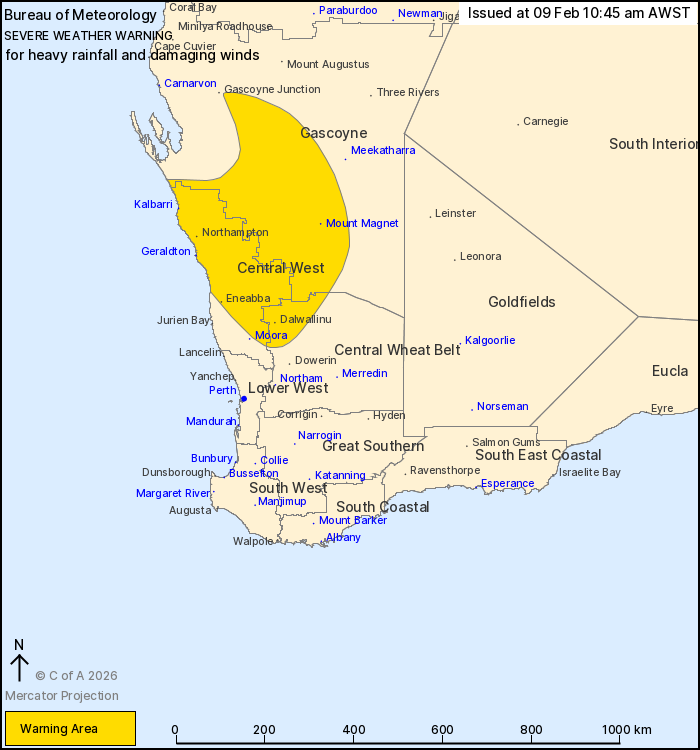
For people in Central West and parts of Gascoyne and Central Wheat
Belt districts.
Issued at 10:45 am Monday, 9 February 2026.
Tropical Cyclone Mitchell to bring heavy rainfall and damaging
winds to the Gascoyne, Central West and Central Wheat Belt
districts from late Monday evening.
Weather Situation: Tropical Cyclone Mitchell is moving southwards
along the Ningaloo and Gascoyne coasts and is expected to turn
southeast and cross the Gascoyne coast later Monday. It will weaken
as it moves inland overnight and transitions into a extratropical
low on Tuesday, bringing heavy rainfall and damaging winds as it
tracks inland.
HEAVY RAINFALL which may lead to FLASH FLOODING is forecast for
parts of the Gascoyne, Central West and northern parts of the
Central Wheat Belt from early Tuesday morning, especially on the
southern and western sides of the low pressure system. Six-hourly
rainfall totals between 25 and 50 mm are likely with localised
falls to 80 mm possible. 24-hour rainfall totals between 50 and 80
mm are likely with localised totals to 120 mm possible.
DAMAGING WINDS GUSTS with peak gusts to 100 km/h are possible from
late Monday evening, particularly to the east of the low pressure
system.
People in the north of WA may experience this type of weather each
year at this time but winds and rain may cause damage to property
and make road conditions hazardous. This type of weather is
unseasonable for people in the Central West and Central Wheat Belt
at this time of year.
Separate Tropical Cyclone and Flood Watches and/or Warnings are
current at the time of issue. Please check
https://www.bom.gov.au/weather-and-climate/warnings-and-alerts/ for
more information.
Locations which may be affected include Geraldton, Kalbarri, Mount
Magnet, Dalwallinu, Eneabba and Northampton.
The Department of Fire and Emergency Services advises that people
should:
* If outside find safe shelter away from trees, power lines, storm
water drains and streams.
* Close your curtains and blinds, and stay inside away from
windows.
* Unplug electrical appliances and do not use land line telephones
if there is lightning.
* If boating, swimming or surfing leave the water.
* Be alert and watch for hazards on the road such as fallen power
lines and loose debris.
* Keep away from flooded drains, rivers, streams and
waterways.
* Be careful of fallen trees, damaged buildings and debris.
* Be careful of fallen power lines. They are dangerous and should
always be treated as live.
* Assess your home, car and property for damage.
* If damage has occurred take photos and contact your insurance
company to organise permanent repairs.
* If your home or property has significant damage, like a badly
damaged roof or flooding, call the SES on 132 500.
09/Feb/2026 02:54 AM