Source: Bureau of Meteorology
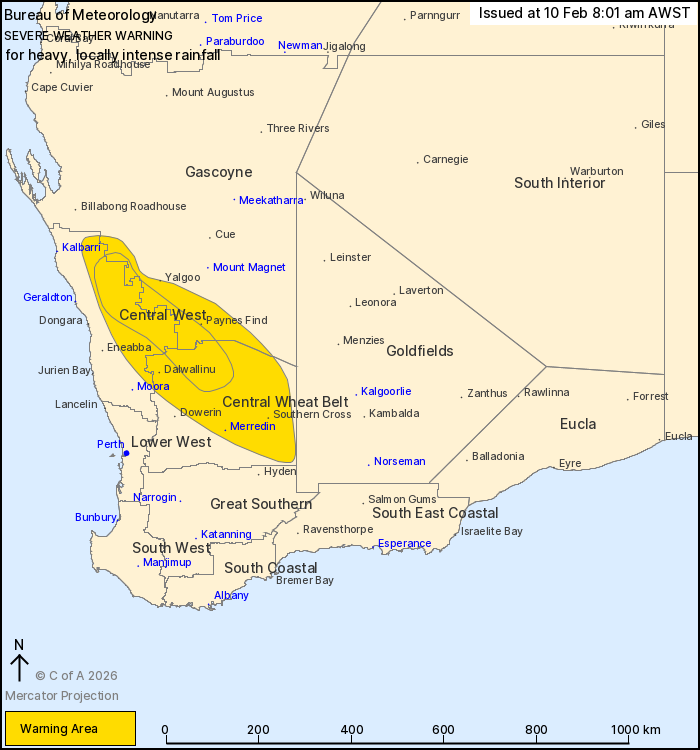
For people in Central Wheat Belt and parts of Gascoyne and Central
West districts.
Issued at 8:01 am Tuesday, 10 February 2026.
HEAVY TO LOCALLY INTENSE RAINFALL AS EX-TROPICAL CYCLONE MITCHELL
TRACKS TO THE SOUTHEAST.
Weather Situation: Ex Tropical Cyclone Mitchell crossed the
Gascoyne coast early this morning and is continuing to track
southeast. Winds around the system have weakened, but heavy to
intense rainfall will persist today before easing late
tonight.
HEAVY RAINFALL which may lead to FLASH FLOODING is forecast for
parts of the Gascoyne, Central West and the Central Wheat Belt
during Tuesday. Six-hourly rainfall totals between 25 and 50 mm are
likely with localised falls to 70 mm possible. 24-hour rainfall
totals between 50 and 80 mm are likely with localised totals to 120
mm possible.
Locally INTENSE RAINFALL is possible on the southern side of the
low pressure system, including the areas around Mullewa, Morawa and
Beacon. Six-hourly rainfall totals up to 90 mm are possible in this
area.
This type of weather is unseasonable for people in the Central
West and Central Wheat Belt at this time of year.
Flood Watches and/or Warnings are current at the time of issue.
Please check
https://www.bom.gov.au/weather-and-climate/warnings-and-alerts/ for
more information.
Locations which may be affected include Merredin, Dalwallinu,
Paynes Find, Southern Cross, Yalgoo, Morawa, Mullewa, Beacon and
Koolyanobbing.
62.2 mm OF RAINFALL WAS RECORDED AT PINDARRING ROCKS IN 3 HOURS TO
07:05 AM.
64.4 mm of rainfall was recorded at Bullardoo in 6 hours to 07:25
am.
52.4 mm of rainfall was recorded at Greenough River (near Yuin
Station) in 6 hours to 07:34 am.
The Department of Fire and Emergency Services advises that people
should:
* If outside find safe shelter away from trees, power lines, storm
water drains and streams.
* Close your curtains and blinds, and stay inside away from
windows.
* Unplug electrical appliances and do not use land line telephones
if there is lightning.
* If boating, swimming or surfing leave the water.
* Be alert and watch for hazards on the road such as fallen power
lines and loose debris.
* Keep away from flooded drains, rivers, streams and
waterways.
* Be careful of fallen trees, damaged buildings and debris.
* Be careful of fallen power lines. They are dangerous and should
always be treated as live.
* Assess your home, car and property for damage.
* If damage has occurred take photos and contact your insurance
company to organise permanent repairs.
* If your home or property has significant damage, like a badly
damaged roof or flooding, call the SES on 132 500.
10/Feb/2026 12:05 AM